Why Your Next Scope Should Be A USB Oscilloscope?
Choosing a high-performance USB oscilloscope is the most effective way to modernize your engineering workflow, which is why your next scope should be a USB oscilloscope. While a traditional benchtop oscilloscope remains common in older labs, many professionals and educators are switching from a benchtop to PC-based oscilloscopes to leverage the superior processing power and high-resolution displays of modern laptops. By choosing a PC-based oscilloscope, you gain a compact, highly portable and cost-effective solution that integrates measurement and data analysis into a single, seamless environment. This software-driven approach, as found with PicoScope oscilloscopes, ensures you never have to compromise on performance or advanced analysis features – no matter the project or budget.
What is a USB oscilloscope?
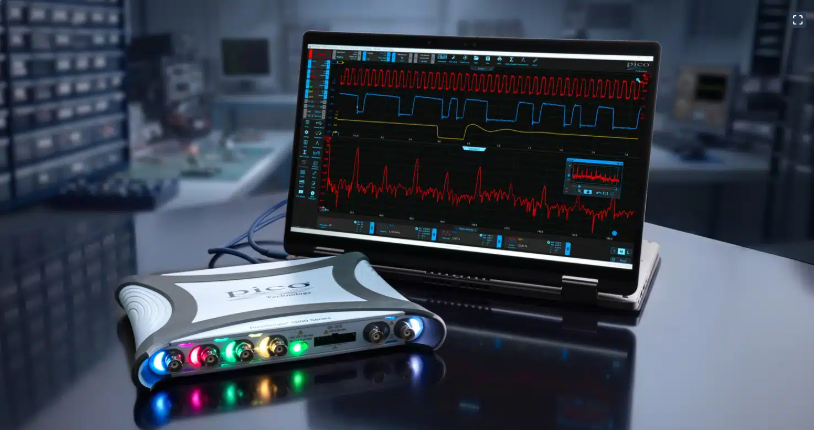
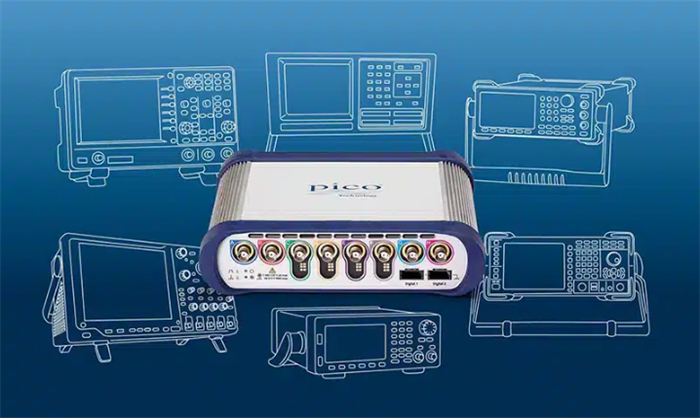
A USB oscilloscope, also known as a PC-based oscilloscope, is a compact, portable test instrument that plugs into a computer’s USB port to measure and analyze electrical signals. Instead of a built-in screen, it uses software on a PC to offer a high-resolution display of waveforms, easier data sharing and more advanced processing features. By using your computer’s monitor, processor and storage, a USB scope offers a cost-effective and space-saving solution compared to a traditional benchtop oscilloscope.
Benchtop oscilloscopes vs. USB oscilloscopes: what are the pros and cons?
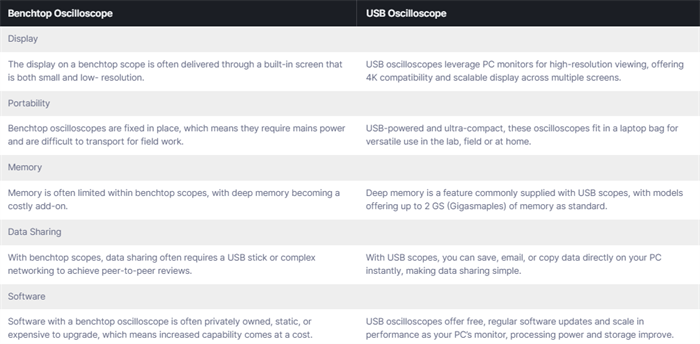
Before switching to a PC-based oscilloscope, you must first understand the differences between a benchtop and a USB oscilloscope. Here, we summarise the features of both models and explain the benefits they offer.
5 Reasons Why USB Scopes are Important for Modern Engineering
1. A familiar and powerful interface
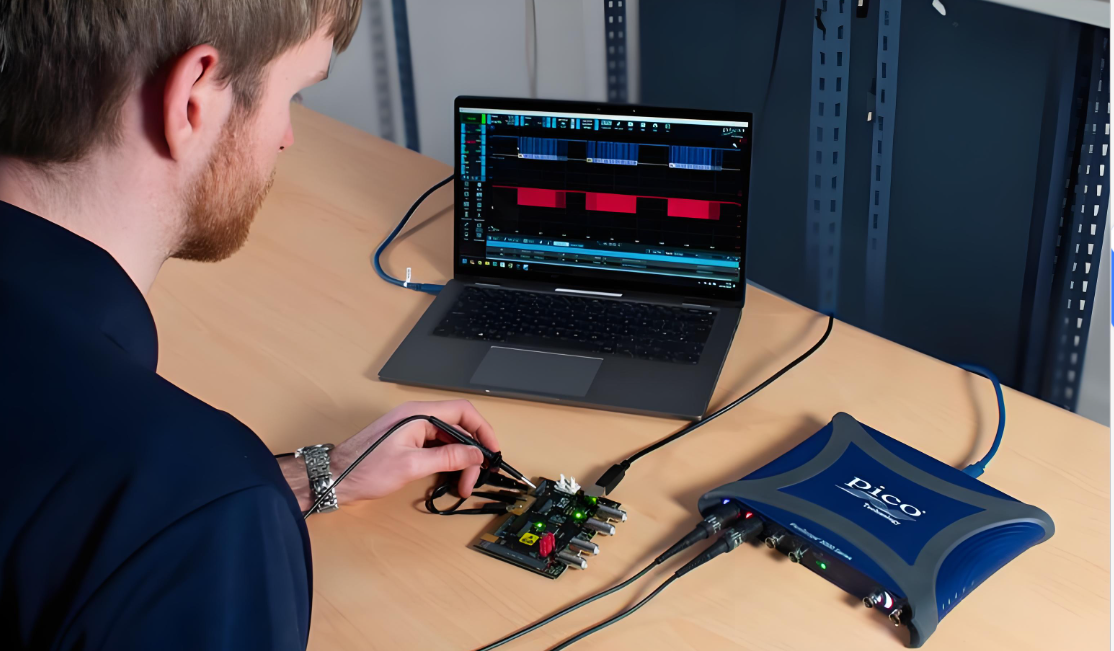
Unlike a standard oscilloscope with a small, built-in screen, a USB oscilloscope uses your laptop or desktop as the primary display. This creates a seamless workflow, since you already use your PC for simulation and data analysis, which means measurements and reporting now happen in one place. This also makes it easy to use, refocusing your efforts on understanding signals and systems rather than fumbling with unfamiliar hardware.
2. A portable oscilloscope for remote and hybrid working
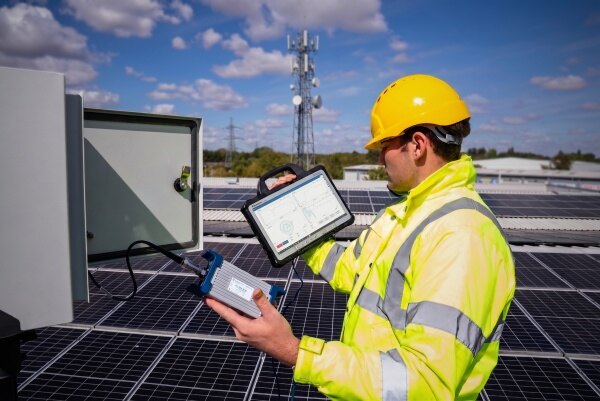
The demand for portable oscilloscopes is growing due to the increasing complexity of projects and the evolution of remote and hybrid working within engineering settings. Compact by design, USB scopes offer increased flexibility compared to fixed equipment, allowing you to carry out precise measurements in a lab environment or where the project takes you – all without switching devices. This means oscilloscopes, like PicoScope Oscilloscopes, offer a modern solution to shrinking office space, congested STEM labs and those projects that require solutions on the move.
3. Scalable and cost-effective
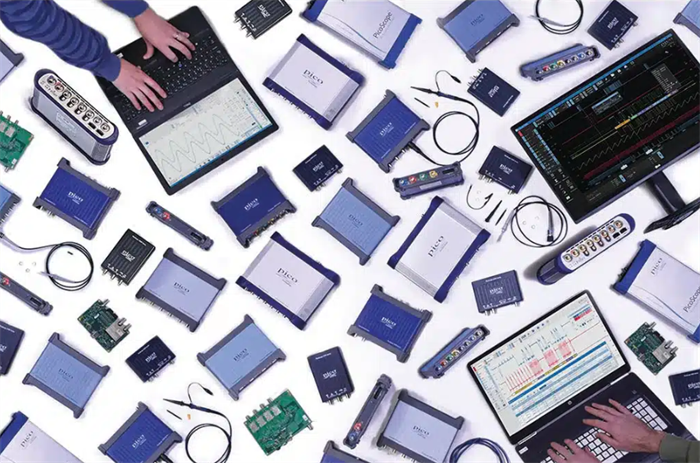
USB oscilloscopes provide high-end performance for a fraction of the cost of some traditional benchtop scopes. This increases access as affordable pricing allows labs to provide more users with direct access to measurement tools, like PicoScope oscilloscopes. The PicoScope 7 software also connects to all PicoScope models, providing one unified system that can grow in capability as PCs and software are upgraded. This means you only need to learn one interface for a variety of projects – no matter the size or complexity.
4. Industry-standard performance
Modern engineering has moved away from standalone hardware toward a reliance on software-driven tools, digital analysis, and automated workflows. By utilizing a PC-based oscilloscope, engineers engage with professional measurement software that mirrors the workflow in top-tier industrial environments. With software-driven workflows, you also enable integrated documentation and instant data sharing for peer reviews, sign off and ongoing reporting.
5. Future-proof technology
A USB oscilloscope is not limited by its hardware. With free software updates, like those found with PicoScope 7 software, you enhance your scope’s capabilities without needing new hardware, ensuring your tool remains relevant over time. A USB oscilloscope is also designed to be multi-disciplinary. It supports everything from basic electronics to advanced biomedical engineering and applied sciences, making it a versatile piece of kit that adapts to any project.
How to use USB oscilloscopes for different applications?
Now you know the benefits of switching to a digital scope, here we explore how best to use a USB scope within different industries and applications.
Embedded Design & Debugging: Use Mixed-Signal Models (MSO) to view analog and digital signals simultaneously, essential for system-level debugging. Deep memory also allows you to capture long time windows at high sampling rates to isolate elusive glitches or intermittent faults.
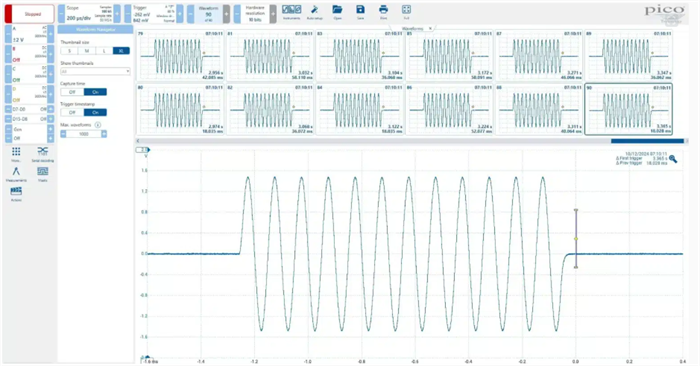
Validating Designs: Leveraging features like DeepMeasure™, found with PicoScope oscilloscopes, you can automatically perform millions of measurements (like rise time, frequency, and amplitude) on a single waveform capture, ensuring your design meets strict specifications.
Streamlined Workflow: With hardware downsampling, you can process data inside the scope and choose what to send to the PC. Ideal for when you need to log long-term but sample fast when faults appear.
Systems Build & Automation: For automated test environments, the PicoScope SDK allows for custom programming in Python, C#, and more. Its compact form factor is also ideal for building directly into custom hardware or rack-mount systems as part of our OEM system integration.
Ready to switch to a USB oscilloscope?
Whether you want a portable, powerful, and precise device or software that scales with your project and business needs, PicoScope oscilloscopes are packed with capabilities.